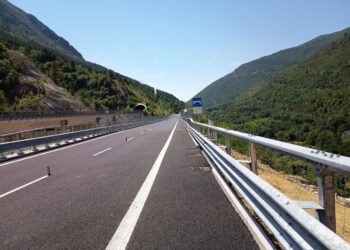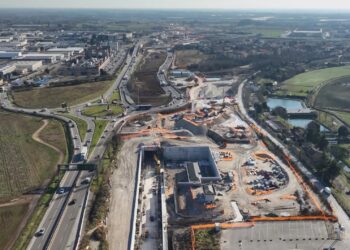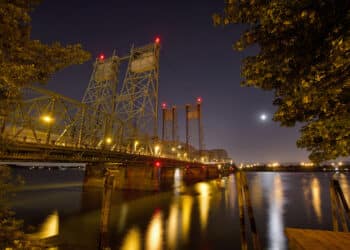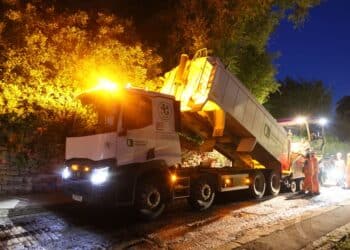
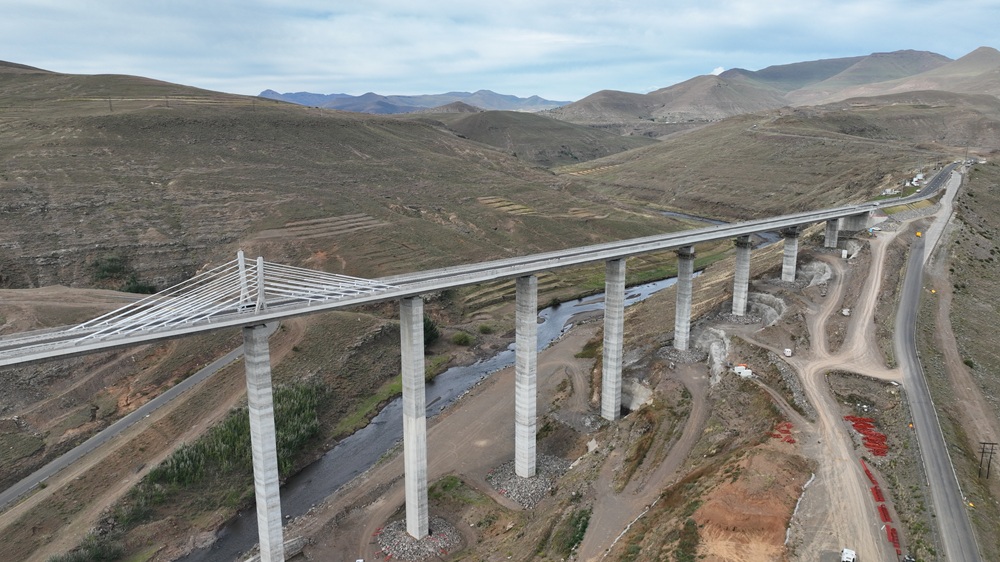
A new $144 million bridge has been completed by a joint-venture team headed by Webuild. The Senqu Bridge is a key component of Lesotho Highlands Water Project, Africa’s largest water transfer scheme developed by Lesotho and South Africa.
The 825m bridge features a 100m central span and is an extradosed bridge, the first of its kind in Lesotho. The project was carried out despite challenging geography and weather conditions. The Senqu Bridge provides road access to the capital city, Maseru, which would otherwise have been cut off by the future reservoir for the Polihali Dam in the Drakenberg Mountains. The bridge provides a key transport link for the kingdom.
The bridge was built by the Webuild Group as lead partner of an international joint-venture on behalf of the Lesotho Highlands Development Authority (LHDA). It marks an important element in the development of Phase II of the Lesotho Highlands Water Project (LHWP). Launched in 1986, the LHWP is a binational initiative between Lesotho and South Africa aimed at harnessing the water resources in the kingdom’s highlands in the largest water transfer scheme in Africa.
Webuild has a 55% stake in the joint venture, while South African firm Raubex Group Limited has a 21% share, Lesotho company Sigma Construction Ltd has a 15% stake and South African firm Enza Construction Pty Ltd has a 9% share.
“The Senqu Bridge is a concrete response to an epochal challenge,” commented Webuild Chief Executive Officer Pietro Salini.“We often forget what life would be like without public infrastructure. It would be a life of unbreachable distances, inaccessible resources and missed opportunities. With this bridge, we have overcome a natural barrier to secure Lesotho’s water and energy future. Major infrastructure projects are enablers of development worldwide and an act of care for communities: they overcome geographical barriers to establish vital connections, supporting economic progress and social well-being.”
With partners from Lesotho and South Africa, Webuild was able to operate in particularly complex climatic conditions, marked by sudden gusts of winds and snowfall, while combining advanced engineering with local skills. The construction required highly targeted engineering choices, including work platforms reaching heights of up to 88m, access roads carved into rock faces and temporary structures adjusted daily to cope with weather conditions. Training programmes and operational and safety procedures tailored to the challenges of the mountain environment were essential.
The Senqu Bridge is the first extradosed bridge in Lesotho, a structure combining features of cable-stayed and girder bridges. This design was selected to ensure high resistance to strong winds blowing from the Drakensberg mountain range. Overall, the bridge features 16 spans, installed using techniques specifically developed to cope with extreme gradients and accessibility limitations. The piers range from 15-90m in height to suit the profile of the valley floor.
Located between the towns of Oxbow and Mokhotlong in the northeast of the kingdom, the bridge is linked to the future Polihali Dam. Without the bridge, the waters of the dam’s reservoir would have submerged sections of the A1 trunk road, isolating Mokhotlong and mountain villages.
Once the LHWP is completed, Lesotho will benefit from additional energy capacity and revenues from water supply to South Africa, while South Africa will gain supplementary water transfer to the industrial Gauteng region, strengthening water security.