A new expressway link project in India is providing a long-awaited transport connection in the country’s highway network and will deliver a much-needed upgrade. The Mumbai to Pune Expressway is a key road transport link for India’s highway system, connecting two major centres of commerce and habitation that are important for the country. It is one of the busiest routes in India, its traffic growth reflecting the nation’s fast-expanding economy.
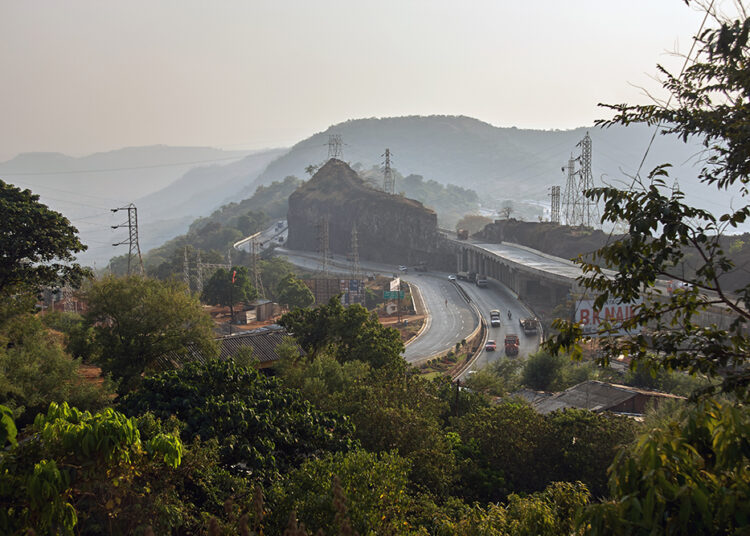
The Mumbai-Pune expressway opened to traffic in 2002 and was named after the former chief minister Yashwantrao Chavan. However, there has been a 19km section on the route, the Khandala Ghat, that does not meet the latest safety standards or traffic requirements and only now is this being superceded by a wider and safer bypass stretch.
Pune and Mumbai are around 147km apart and driving between the two cities will take around three hours at present, presuming that there are no delays due to extra vehicle numbers, crashes or landslides on the route. The tolled expressway linking the cities features three lanes of traffic either direction and the increasing numbers of vehicles on India’s roads have resulted in the route suffering heavy congestion.
The construction of two new tunnel sections and two new bridges will deliver a better transport connection, making a significant reduction in journey times for drivers using the expressway. With more traffic lanes, the new bypass link will offer greater capacity that will reduce congestion during peak periods.
This new expressway stretch will also help to cut the journey distance by around 6km and reduce travel times by around 30 minutes. More importantly for some, the new stretch featuring the new tunnels and bridges will also mean that drivers will no longer have to use the notoriously risky Khandala Ghat. This section of the expressway has developed a bad reputation for its steep gradients, sharp curves and occasional landslides, so the new stretch will boost safety considerably.
Called The Missing Link Project, the new tunnels and bridges will provide a bypass for the Khandala Ghat, which has been the scene of many crashes. The stretch has also suffered from several landslides that have blocked the route at various times and which occur most frequently during the monsoon period. The safety of this stretch is of concern, particularly when the weather conditions are poor, and there were 191 serious crashes on the Khandala Ghat stretch in 2024 according to official data.
Perhaps the most important reason for the bypass project is how traffic volumes on the Mumbai-Pune Expressway have increased considerably since it first opened in 2002. This reflects the growing prosperity in India, with private vehicle ownership having increased significantly.
The expressway typically handles an average of around 75,000 vehicles/day for much of the week. But during weekends or holiday periods, traffic volumes can soar as high as 110,000-120,000 vehicles/day. When this happens, there can be tailbacks and long delays for drivers using the route.
However, the new bypass stretch between the Khopoli Exit and the Sinhagad Institute will provide a significant upgrade, delivering the additional capacity required and becoming a “zero-fatality corridor” with improved safety for users. If the current construction progress is maintained, the new section should be ready for use by late 2025 or early 2026.
The project is being managed by the Maharashtra State Road Development Corporation (MSRDC). Approval for the project was given by the Maharashtra Government in mid-2017. The contract for the general consultancy work was awarded to Geodata and Louis Berger, which handled the work in a joint venture partnership.
The new bypass is featuring two stretches with twin tube tunnels, with four lanes of traffic in either direction. It will also feature two major bridges, one measuring 750m although the 650m bridge is the more impressive, featuring an innovative and unusual design. Construction of its bridge pylons has presented a major engineering challenge.
The contract for the tunnels was awarded to Navayuga Engineering Company. One of the dual tube tunnel stretches is nearly 9km in length, while the other dual tube tunnel sections measures around 1.75km-long. The longer of the tunnel stretches reaches a maximum depth of around 52m and runs underneath a lake, while also being the longest road tunnel in India and one of the widest in the world at 23.5m.
These tunnels have been driven using conventional drilling and blasting techniques, which was evaluated as the method best suited to the geology of the area. The first breakthrough for one of the tunnel sections was in the third quarter of 2021.
Bridging the cap
The infrastructure and engineering multinational corporation Afcons Infrastructure is carrying out Package-II of the project. This package of works involves widening the expressway and constructing the two cable-stayed bridges.
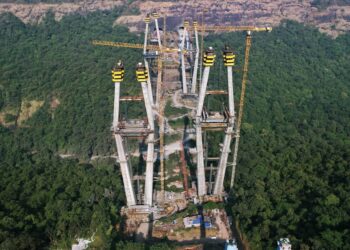
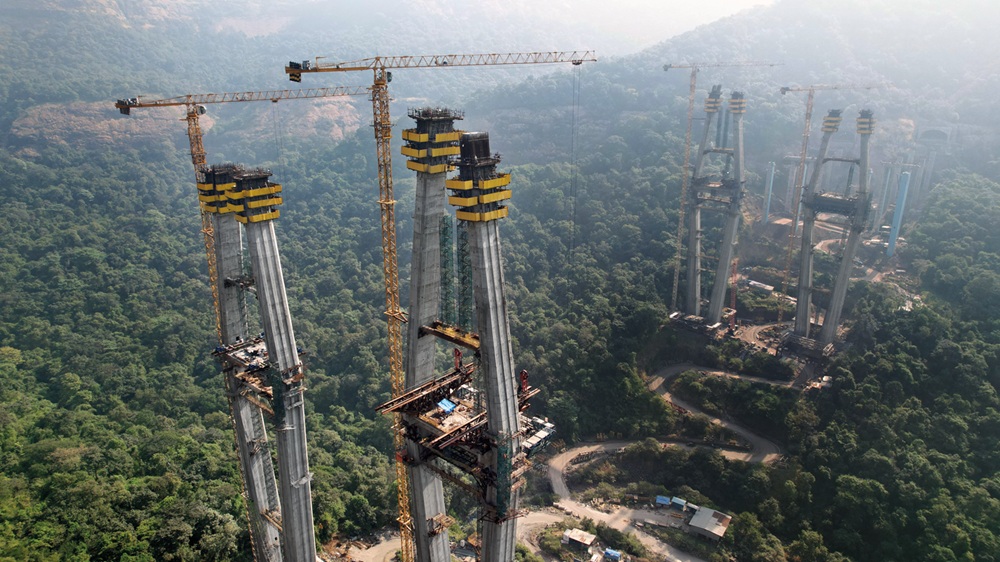
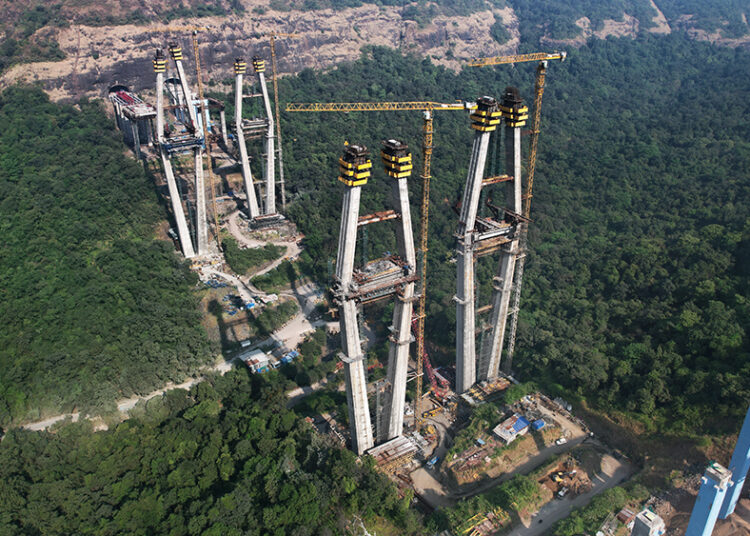
The most impressive of these bridges and arguably the aesthetic centrepiece of the new bypass will be the 650m-long cable-stayed structure, featuring a diamond-shaped pylon design. With the pylons measuring 182m-high, this will make the bridge one of the tallest ever built in India.
However, the construction of these unusual diamond-shaped pylons has presented a complex engineering challenge. This pylon design has a complex geometry, with inclinations in different directions.
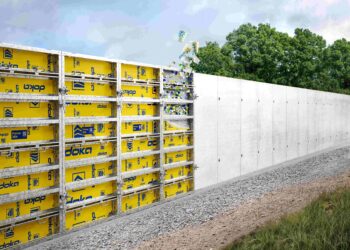
Formwork specialist Doka has provided an important solution to the construction of the pylon. Doka says that its engineers were able to devise a tailored method that combined the use of the Xclimb60 Short Track and Automatic climbing formwork SKE100 plus systems.
The use of these systems is helping to deliver both he simpler and the more complex portions of the pylon construction. Doka says that using its equipment is helping to deliver the project quickly as well as safely.
The use of the SKE50 plus and SKE100 plus automatic climbing formwork as well as the Xclimb 60 guided climbing formwork and the Top 50 large-area formwork is helping to ensure rapid and safe construction progress according to Doka. At the same time, the use of this equipment is minimising manual handling and reducing risks for on-site crews, while also cutting the construction timeline.
The 650-m long bridge features parallel decks, with four of the innovative diamond-shaped pylons. The central span of the bridge is 305m-long and the decks are around 100m from the ground at the highest point.
Growing cities
Both Mumbai and Pune are highly important cities in India’s Maharashtra State, with growing international profiles.
Mumbai in particular has become a powerhouse of the Indian economy. With a population now estimated to be around 12.5 million, it is a mega city growing at a fast rate. The Mumbai Metropolitan Region has an estimated population of 23 million, though not yet reaching the 30 million of Metro Tokyo.
Mumbai has the highest number of billionaires of any city in Asia and its transport infrastructure has been groaning under the weight of a steady increase in vehicle numbers. Mumbai is understandably a major focus for infrastructure development, with several major projects underway to boost the city’s transport connections.
Work is underway for the Versova-Dahisar Link Road (VDLR), the second phase of the Mumbai Coastal Road Project (MRCP), spanning a length of 23km. Packages C & D are the two parallel Underground tunneling packages of VDLR project, each extending 3.1km in length. The planned project will connect the suburbs of Versova and Dahisar along Mumbai’s western coastline, easing traffic congestion on major routes such as the Western Express Highway.
Underground tunnel sections will play a major role in areas such as the city centre and densely built urban regions. The project owner is Brihanmumbai Municipal Corporation, and the client is Megha Engineering & Infrastructures Ltd (MEIL). Piling work has now been started by contractor BMC for the 4.5km stretch of the Mumbai Coastal Road (North) connector. This will provide a link between the Mindspace in Malad to the Dindoshi sessions court.
Meanwhile, the links between Mumbai and surrounding areas are also being improved, not just the road connecting with Pune.
Construction is underway for India’s massive $3.2 billion Marine Superhighway project. This new route will provide a faster link between Mumbai and Goa. Once the 500km route is complete, it will cut journey times by reducing traffic congestion on the existing NH66 highway connecting Mumbai and Goa. In addition, the NH-66 is being widened to four lanes with the project expected to cut travel times between Mumbai and Goa.
And costing an estimated $13 billion, the 1,390km Delhi-Mumbai Expressway should be ready for traffic in the third quarter of 2025. Some stretches of the Delhi-Mumbai Expressway route are already in use, with over 1,100km of the route having been completed. The new expressway will reduce the distance between the cities by around 180km and will cut journey times by an estimated 50%, from 24 hours to just 12 hours. The expressway will feature four lanes in either direction although some stretches will have more lanes as required.
For its part, Pune had a population listed at 7.2 million for the 2011 census but which has grown considerably since. A hub for India’s IT sector and auto industry as well as for the country’s educational institutions, Pune is also a historical centre for culture in India.
As with Mumbai, Pune’s transport infrastructure has been struggling to cope with the rapid increase in the city’s vehicle population. Various infrastructure projects are planned and are underway. Contractor G R Infraprojects is handling the $230 million project to build a section of the ring road for Pune. This 9.3km section of road will run between Kalyan/Rathwade and Shivare/Kusgaon and the work is expected to take 36 months to complete.
Construction of the access-controlled ring road will cut congestion and journey times in the city, which suffers from traffic delays at peak periods. Costing an estimated $1.2 billion, the 105km ring road will feature dual lanes in either direction including 13 tunnel stretches, seven viaducts, eight flyovers and four bridges spanning rail lines.
The package of works will be handled under the engineering, procurement and construction (EPC). The contract was awarded through MSRDC Pune Ring Road Limited and Maharashtra State Road Development Corporation Limited (MSRDC).