Costing around $3.9 billion, the Hampton Roads Bridge-Tunnel (HRBT) upgrade Expansion project for Virginia will improve traffic flow for a key stretch of I-64 and US 60. The project will make a huge difference to the area once complete, removing a major congestion point for traffic. The new tunnel and trestle link will double the capacity of the route, easing congestion and improving travel times, as well as delivering a safe emergency evacuation route in case of extreme climactic conditions.
The HRBT is a 5.6km, four-lane crossing that comprises bridges, trestles , artificial islands, and tunnels. The tunnel stretch runs underneath the shipping channels connecting to the Hampton Roads harbour to the Chesapeake Bay in South-East Virginia.
The bridge and tunnel system connects the cities of Hampton and Norfolk. Each city is connected by a pair of two-lane trestle bridges to an artificial island. Hampton is connected to the North Island and Norfolk to South Island. These artificial islands are themselves connected by two tubes, each carrying two lanes for vehicles.
The area was initially linked by a ferry service but with growth in population in post WWII, this was unsuitable for the volume of passengers it had to handle so a better connection was planned. Built in 1957 at a cost of around $44 million, the westbound section of the HRBT set a technical precedent, being the first tunnel in the US to connect to artificial islands. The single tube carried both eastbound and westbound traffic. Construction for the bridge–tunnel stretch facility running parallel then commenced in 1972 and cost $95 million to build when it opened in 1976.
This massive project is the largest infrastructure work ever carried out in by the Virginia Department of Transportation (VDOT) but and will deliver huge transport benefits for the region. The improvements to the I-64 corridor lie between the west of Mallory Street Interchange in Hampton and to the east of Patrol Road in Norfolk. Once complete, the work will add a third full-time lane and a new part-time shoulder lane to I-64 in each direction. The two new tunnels will increase capacity from the current four tunnel lanes to eight. In total, the project will see upgrades to nearly 16km of I-64, including the 5.6km for the new trestle and tunnel sections. On land there will be three full-time lanes in either direction with a fourth operating as a part-time shoulder lane, while there will be four lanes in either direction for the trestle and tunnel stretches. The project will also see two five new bridges being added and twenty others replaced improved, while several key junctions will be upgraded.
The Virginia Department of Transportation (VDOT) is managing the HRBT Expansion project but admitted that the project has faced a number of delays to its timeline, due to what it describes as unforeseen cost and schedule impacts. The opening of the link will now be delayed until 2027.
This massive construction project was awarded by VDOT to a joint venture, Hampton Roads Connector Partners, comprising Flatiron Dragados USA, Flatiron Dragados Constructors, VINCI Construction Grand Projets and Dodin Campenon Bernard. VDOT awarded the Hampton Roads Connector Partners joint venture (JV) a design-build approach to the project in 2019.
A Design JV for the work was formed by HDR and Mott MacDonald, with HDR taking the role of managing partner. With its position as Design JV lead, HDR has been responsible for the management of the design process. The firm’s scope included roadway widening, design of 27 25 bridge replacement and widening jobs, design of geotechnical and drainage works and support for the utilities. Also included was ensuring environmental compliance for the project as well as the lighting and signal design and ITS systems for the link.
The key section of the HRBT Expansion project is for the two new tunnels that run underneath the main shipping channel, with each carrying two traffic lanes. VDOT opted for a model that would allow the contracting partners to develop the solution for the project, for either an immersed tunnel or bored tunnel.
There are 10 tunnels in the Hampton Roads area and these existing links are all of the immersed tube type. But when the HRBT Expansion project was considered, the contracting partners decided to opt for bored tunnels instead of the immersed types used previously.
The reasoning against a bridge option from both VDOT and the Hampton Roads Connector Partners joint venture was that the geology of the area features soft soils, which are not well-suited to the heavy-duty foundations needed for bridge construction. Another factor against a bridge solution was that the height clearance needed to allow vessels to pass underneath would have required long bridge approaches and involved costly building acquisitions and subsequent demolition works. By comparison, the geology meant using a TBM to bore tunnels would be comparatively straightforward, with this method also allowing an unobstructed passage for vessels using the waterway.
Geotechnical investigation work was carried out at the planning stage for the project. Data from this was combined with the records of earlier projects carried out in the region. An analysis of the information highlighted the Yorktown layer, a band of silty clay 18.3-24.4m deep, would be highly suitable for the tunnelling work.
The HRBT Expansion project is of note as large TBMs have only been used a few times to drive a tunnel in the US. The dual deck, 3.2km SR 99 project in Seattle was bored by TBM, as was the 1.26km Port Miami Tunnel built by MAT Concessionaire, in partnership with the Florida Department of Transportation (FDOT), Miami-Dade County and the City of Miami. Tunnelling work for the new Chesapeake Bay Bridge-Tunnel project has also been carried out using a TBM.
The most complex portion of the HRBT project is undoubtedly the construction of the two tunnels, which measure 13.7m in diameter, around 2.4km in length and reach maximum depths of around 45m below the water. These are being driven using a huge tunnel boring machine (TBM ) configured for the task and costing around $70 million. The variable density TBM is the largest machine of its kind ever built and started its first drive from the 19m-deep tri-cell, slurry wall, launch pit the contracting team built on the South Island. To allow sufficient space for this work, the South Island had to be increased in area by 1.2ha.
Enlarging the North and South islands made way for the bored tunnels themselves, as well as the structures for the tunnel approaches and the tie-ins for the new bridge decks.
The TBM started its work for the first drive towards the North Island (which had to be increased in area by 6ha for the work) in April 2023 and finished this bore on April 17th, 2024. After breaking through as planned, engineers used a massive turntable (featuring liquid nitrogen to reduce frictional resistance) to turn the huge the TBM around, no small task given its size and weight. It was then able to restart its boring work, heading in the direction of the South Island.
The TBM has a cutting head that has been equipped with disc cutters or a combination of rippers and scrapers, depending on which part of the bore is being excavated. The disc cutters were used to cut through the head wall at the shafts. These were then exchanged for rippers and scrapers to bore through the soft soils under the channel. To ensure the TBM operates efficiently with the cutting tools in optimum condition, the machine is equipped with wear monitoring sensors and these have been augmented by regular visual inspections.
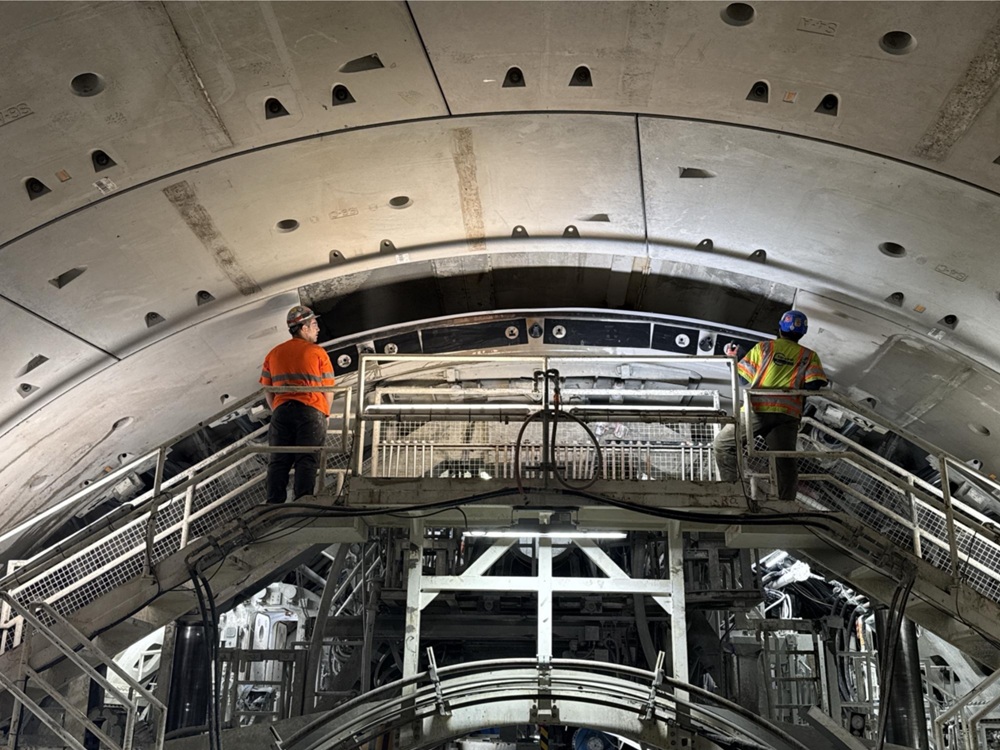
While the TBM’s cutting head bores through the ground, the machine also has equipment that install the segmented tunnel liners to the rear. The precast segments have been manufactured at a site in Cape Charles, Virginia, having been transported by barge to the site. Once the twin bores have been completed, this will have required the installation of around 21,000 of the precast segments. Meanwhile slurry for the boring operation has been produced by a facility located on the South Island.
When the bore for the first 2.4km stretch of the new tunnel was completed, nearly 1,200 tunnel rings had been installed at the rear of the TBM.