After a multi-day operation, the first of 89 concrete elements for the Fehmarnbelt Tunnel between Denmark and Germany is now in place on the seabed. The project will provide a new transport link between North Germany and Denmark.
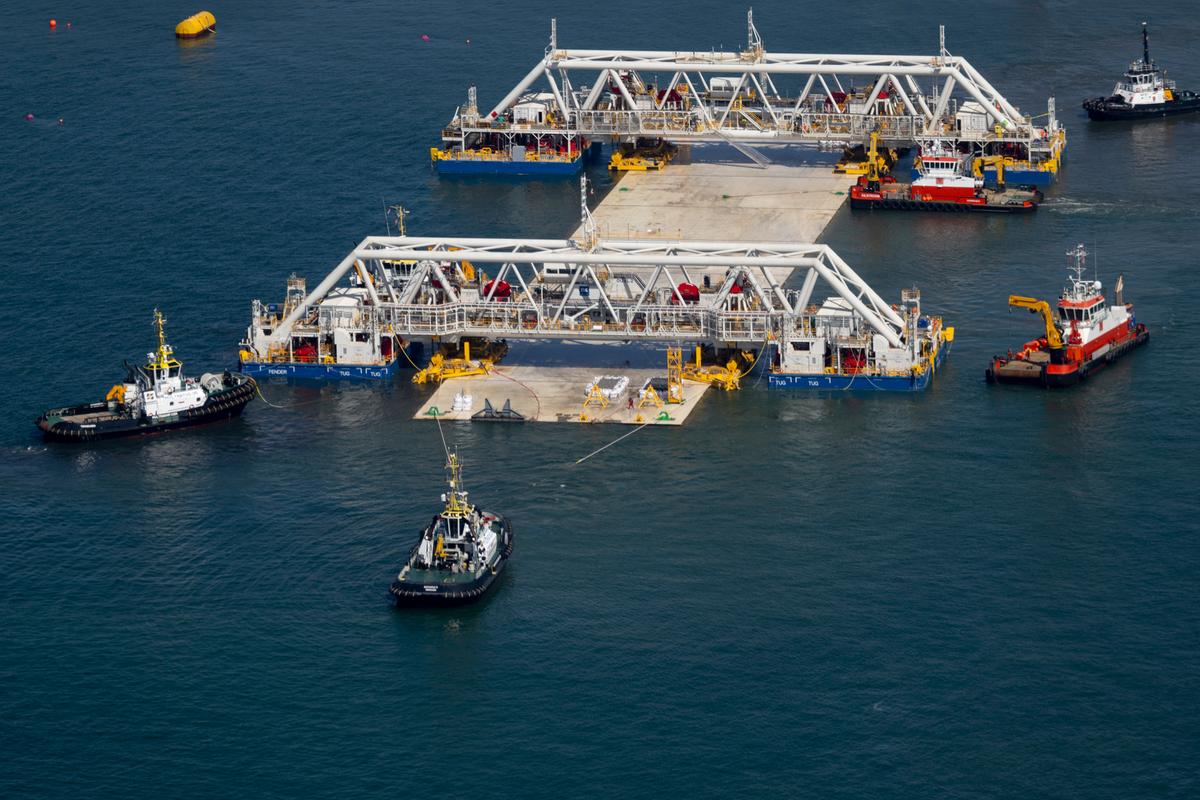
Five tugboats and the special immersion vessel called Ivy floated the tunnel element from the tunnel factory at Rødbyhavn on the Danish island of Lolland to the immersion point off the Danish coast
Around 14 hours later, the element reached its destination and was ‘sunk’ downwards into the tunnel trench in front of the portal on the Danish end of the tunnel. The element was connected to the portal using hydraulic arms. The position was then finally confirmed by precise laser measurements inside the immersed tunnel element.
The two immersion pontoons were towed back to the work harbour. They will be replaced by another special vessel, which will place large quantities of gravel along the sides of the element. This ensures it remains securely in position.
The contractor said that this is the first time in history that series-produced tunnel elements of this size have been used to build a tunnel. The standard elements are enormous, hollow concrete structures which are 217m long and weigh more than 73,500tonnes. The elements are divided into five tubes – two for the future motorway, two for the railway and one for technical installations. Completion of the 17.6km-long tunnel is expected in 2031.
“We are both happy and relieved,” said Mikkel Hemmingsen, chief executive of Sund & Bælt, owner of the future infrastructure. “Our technology, our equipment and our contractors have demonstrated their capabilities and achieved something no one has done before. It is a very big day for the project, for Denmark and Germany and for Europe,”
In the coming years, the remaining 88 elements will be immersed one by one and connected in an excavated trench in the seabed up to 40m below sea level.
At nearly 18km, the Fehmarnbelt tunnel will be the longest immersed tunnel in the world and will be part of the European Union’s Trans-European Transport Network (TEN-T). It has been designated a priority project by the European Commission, which has awarded the project roughly €1.3 billion in construction funding.
The tunnel, approved in 2015, was designed and financed by the Danish state-owned infrastructure operator Femern A/S. The budget was around US$8.2 billion – making it largest traffic investment in Denmark’s history. Consruction cost will be recouped partly though tolling. Germany plans to pay another €800 million to connect the crossing to its motorway network.
“The immersion of the first tunnel element is a historic achievement,” said Apostolos Tzitzikostas, European Commissioner for Sustainable Transport and Tourism. “The world is watching and you are showcasing European engineering and construction at its very best. The tunnel will connect regions more closely and create new momentum between Malmö, Copenhagen, Hamburg and onwards into Europe. The European Commission will continue to support this project all the way.”
When the tunnel is completed, it will be possible to cross the Fehmarnbelt in 10 minutes by car and seven minutes by train. The tunnel will also enable fast railway connections between the Danish capital Copenhagen and Hamburg in northern Germany in two and a half hours, half the time it now takes.